If you own an ash tree in Mid-Michigan, the clock is ticking. Emerald ash borer has already killed tens of millions of ash trees across the state, and it doesn't skip yards. The hard part is this: by the time most people notice their ash looks thin, the tree is often already in trouble — and you've got a real decision to make between treating it and taking it down.
Let's walk through how to read your tree, and how to make the right call.
What Emerald Ash Borer Does
Emerald ash borer (EAB) is a small metallic-green beetle whose larvae do the damage. They tunnel under the bark and feed on the layer that moves water and sugars through the tree. Those winding tunnels choke off the tree's supply lines, and the canopy starves from the top down.
Every true ash is at risk — green ash, white ash, black ash. Once the beetles are in your neighborhood, an untreated ash usually dies within two to four years.
Signs Your Ash Tree Is Infested
Canopy thinning from the top down
This is usually the first thing people see. The upper third of the crown goes sparse and pale while the lower branches still look fine. Bare tips at the top are a red flag.
D-shaped exit holes
When adult beetles chew their way out, they leave a distinctive D-shaped hole about an eighth of an inch across — flat on one side, rounded on the other. No other common pest leaves that shape.
Woodpecker flecking
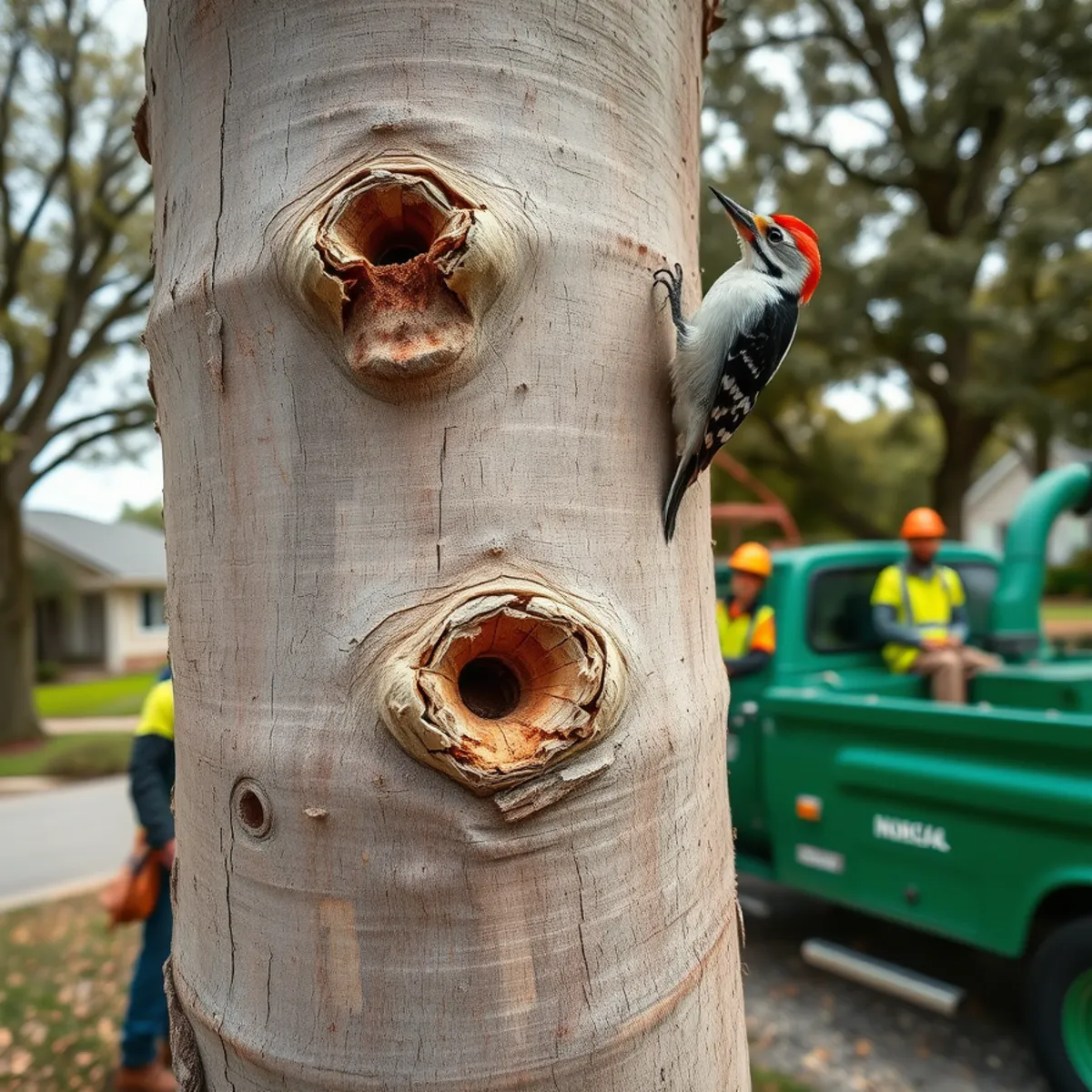
Woodpeckers hunt the larvae, stripping off patches of outer bark to get at them. That blond, flecked look on the trunk and larger limbs — we call it "flecking" — often shows up before you'd ever spot an exit hole.
Sprouts and splitting bark
A stressed ash will throw up epicormic sprouts — shoots straight from the trunk and root flare. Peel a bit of loose bark and you may find the S-shaped, serpentine tunnels (galleries) packed with sawdust underneath.
Treat or Remove? How We Think About It
There's no single right answer. It comes down to the tree's health, its location, and what it's worth to you. Here's the honest framework we use with homeowners.
When treatment makes sense
If the canopy is still mostly full — less than about a third gone — a healthy ash is a strong candidate for treatment. The standard approach is a systemic insecticide, usually a trunk injection, repeated every one to two years for the life of the threat.
Treatment makes the most sense when:
- The tree is structurally sound and well-placed.
- Less than a third of the canopy is thin or dead.
- It's a shade tree you'd hate to lose or expensive to replace.
Ongoing tree disease and pest treatment is far cheaper than removing and replacing a mature shade tree — as long as you start early.
Timing your treatment
Insecticide treatments work best applied in spring to early summer, when the tree is actively pulling the product up into the canopy and the new larvae are just getting started. It's not one and done. Plan on repeating the treatment every one to two years for as long as borer pressure stays high in the area — which, for most of Mid-Michigan, is the foreseeable future. Skip a cycle and the borers move right back in.
When removal is the smarter call
Once an ash has lost half its canopy or more, insecticide rarely brings it back. At that point you're spending money to slow the inevitable, and the tree is becoming a hazard.
Dead ash are genuinely dangerous. The wood dries out and turns brittle fast, so dead ash shed limbs and fail with no warning — a serious problem near a house, driveway, or power line. That brittleness also makes them harder and riskier to climb, so the longer you wait, the tougher the removal.
When a tree is too far gone, planned ash tree removal on your schedule beats an emergency call after it drops a limb on the garage.
Not sure which way to go?
This is exactly the kind of judgment call worth a professional set of eyes. Our arborist consultations and tree-risk assessments put a number on how much canopy is left, whether the structure is still safe, and whether treatment is a smart bet or throwing good money after bad. We do plenty of these around East Lansing and DeWitt, where mature ash still line a lot of streets and backyards.
What to Do With the Wood
Don't move ash firewood out of the area. Hauling infested wood is one of the main ways EAB spread across Michigan in the first place. Burn it where you cut it, or chip it — and check current firewood-movement guidance before you take any ash anywhere.
If we take down a dead ash for you, we handle the wood the right way so you're not the reason it turns up in the next county over. Cut, chipped, or seasoned on site, the goal is the same: keep the beetles from catching a ride.
Don't Wait on a Declining Ash
With emerald ash borer, timing decides your options. Catch it early and you can often save the tree. Wait too long and removal becomes the only safe path — and a more expensive, more dangerous one.
If you've got an ash looking thin up top, call us at (208) 635-2100 for a free estimate. We're family-owned, licensed and insured, and we'll give you a straight read on whether your tree is worth treating or ready to come down.
Frequently asked questions
Tree service near you
Written by
Hayworth Tree Service