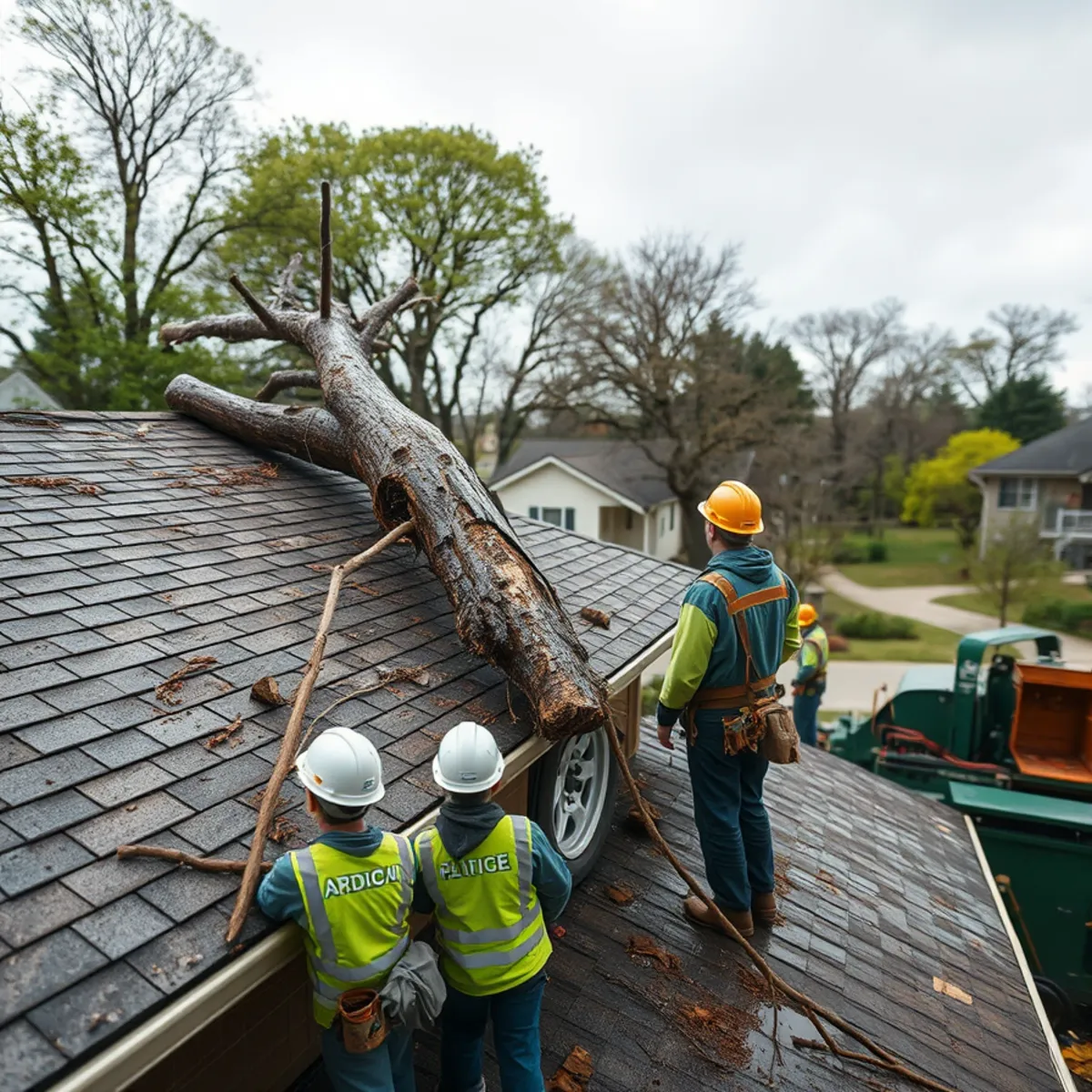
The wind is still howling and there's a limb through your porch roof. Or a whole tree is leaning against the house, roots half out of the ground. It's a sick feeling — and in the moment, it's hard to know what to do first.
Take a breath. Here's the order to work through it, from an arborist who's cleaned up after a lot of Michigan storms.
First: make sure everyone is safe
People before property. Every time.
If anyone is hurt, call 911. If a tree or limb has come down on the house, get everyone out of that part of the building and stay clear — damaged limbs and cracked trunks can shift or drop with no warning. A branch that looks "settled" can be holding a tremendous amount of tension.
Don't go poking at it to see how bad it is. That's how people get hurt after the storm has already passed.
Downed power lines: assume they're live
If a tree took a power line down with it — or is leaning on one — treat every wire as energized and deadly.
Stay back at least 35 feet. Keep kids and pets inside. Don't touch the tree, a fence, or anything else the wire might be in contact with, because electricity travels. Call your utility and 911, and let them de-energize the line before anyone goes near it.
We won't touch a tree tangled in power lines until the utility has cleared it, either. No tree is worth it.
If a tree is on your house
Once you know everyone's safe and there are no live wires, here's the move:
- Get people and pets out of the affected rooms.
- Shut off power to that area at the breaker if you can do it safely and nothing is wet.
- Cover interior openings with a tarp only if you can do it from inside — never climb onto a storm-damaged roof.
- Call for emergency tree service. This is exactly the kind of call we drop everything for.
Getting a heavy limb or a whole tree off a structure is not a DIY job. There's stored tension in bent wood, the load can shift, and one wrong cut can bring the rest down on you or the house.
Document everything for your insurance
Before cleanup starts, get out your phone.
Take photos and video from a safe distance — the tree, the damage to the house, any vehicles or fences, the whole scene. Wide shots and close-ups. Then call your homeowner's insurance to start a claim and ask what they need.
Most Michigan policies cover storm tree damage to structures, though every policy is different. Good photos and an itemized estimate make the claim go smoother. We can provide a written estimate for the work, which is usually just what the adjuster wants to see.
What not to do
A few hard-earned lessons:
- Don't climb on the roof or up the tree. Wet, damaged, and under tension is a bad combination.
- Don't cut anything under load unless you truly know what you're doing. Spring-loaded limbs whip back hard.
- Don't run a chainsaw near power lines. Ever.
- Don't wait days on a compromised tree hanging over the house. What's stable tonight may not be after the next gust.
When it's an emergency vs. when it can wait
Call right away — day or night — if:
- A tree or big limb is on the house, garage, car, or a power line.
- A tree is leaning hard, or the root plate is lifting out of the ground.
- A limb is hung up in the canopy over a driveway, walkway, or play area.
- The road or your only way out is blocked.
It can usually wait for a scheduled visit if:
- The tree is down in an open part of the yard, hurting nothing.
- You've got branches and debris to clean up but nothing threatening the house.
Either way, once things settle we handle the storm damage cleanup — hauling brush, cutting up the trunk, and clearing the yard. If a tree is too far gone to save, we'll talk through full tree removal and what comes next.
Why Michigan storms hit trees so hard
Our weather throws a lot at a tree. Ice storms glaze every twig and can add hundreds of pounds to a single limb. Heavy, wet lake-effect snow piles onto branches until they bend and snap. And a spring thaw soaks the ground soft, so a stiff wind can push a big tree over roots and all — a failure we see every year once the frost comes out.
Some species take it harder than others. Fast-grown silver maple and cottonwood have brittle wood that ice punishes. Tall white pines catch heavy snow loads. And any ash already killed by emerald ash borer is a standing hazard the moment the wind picks up. Knowing which trees on your lot are the weak links is half the battle — and it's worth a look before the next front rolls through.
After the danger passes, look at what's left
Storms stress the trees that stayed standing, too. After the crew clears the immediate hazard, it's worth having a knowledgeable eye check the rest of your yard for cracked crotches, hanging deadwood, and leaners that might not make it through winter. Catching a weakened tree now beats meeting it again during the next storm.
We work all over Mid-Michigan, from Lansing to DeWitt and the surrounding towns, and we respond fast when the weather turns.
Storm damage? Call us now.
If a tree is on your house or threatening it, don't wait it out. We're family-owned, licensed and insured, and we respond fast to storm calls across the Capital region — including emergencies. Call us at (208) 635-2100 and we'll come out. Free estimates, honest answers, and a crew that's cleaned up after plenty of Michigan storms.
Frequently asked questions
Tree service near you
Written by
Hayworth Tree Service